

Skip to content
E-Commerce Agency in China

Pinduoduo’s Live-Streaming Real Estate Sale: Innovation or Loss-Leader?

11 min read
Philip Chen

At 20:00 on July 14th, with the cheers of the on-site staff, Pinduoduo and Haiya Group launched a live-stream for group purchases of real estate in China.

This new type of selling properties has reached a record high sale of 1122 transactions in 24 hours! The success of this event allowed Pinduoduo to realize another successful expansion of its group-buying empire.

As for the real estate industry, which has not yet emerged from the impact of the coronavirus crisis, such dazzling results also let everyone see another possibility for real estate e-commerce in China.
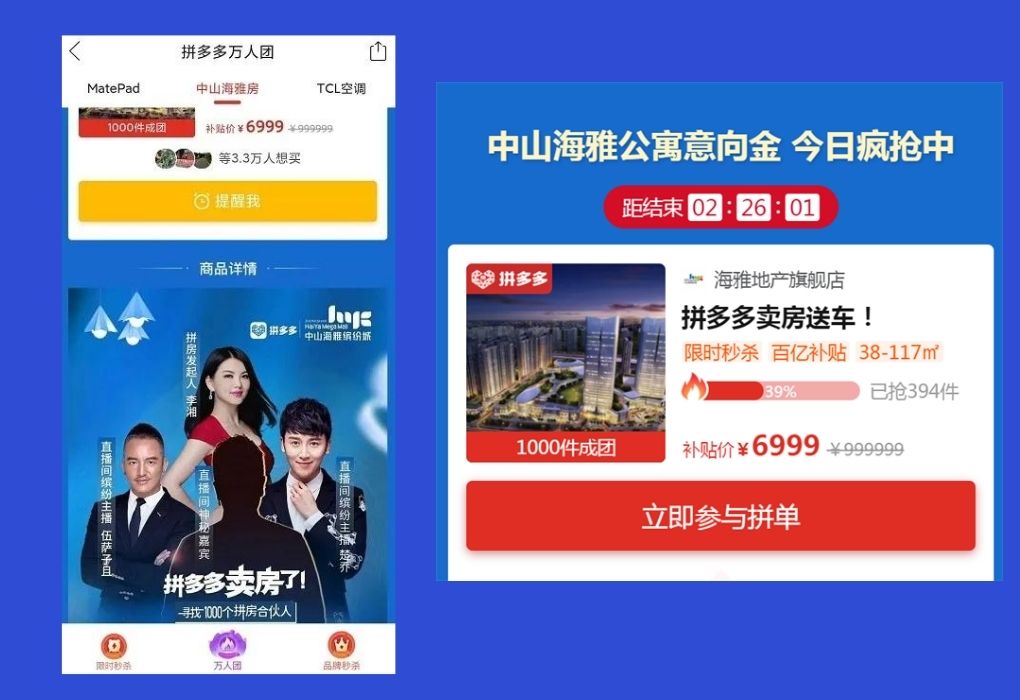
PDD’s advertising for selling real estate on live-stream

China’s recent real estate market

The real estate sector in China is a key part of the world’s second-largest economy. Its development has experienced a long-lasting boom over the last decade for several reasons:

  • Urbanization (associated with rising demand for houses)
  • Upgrading of living standards
  • Rising real estate investment due to inflation
  • Government stimulation of the housing sector

In 2018, the total market sales of the real estate reached around 15 trillion yuan, accounting for nearly 17 percent of China’s GDP.

Chinese real estate market during the epidemic of 2020

At the moment of the coronavirus epidemic, most industries are suffering in China, and the real estate industry bears the brunt.

Data from the National Bureau of Statistics of China shows that in 2019, property investment — including homes, offices, hotel and retail places — for the first five months of the year, fell 0.3%, far less than in previous months as the economy begins to gradually emerge from its coronavirus shutdown.

According to Reuters, China’s property sales by floor area was down to 9.7% in May, compared with a 2.1% fall in April.

For recovering the Chinese property sales market, the central bank continued injecting liquidity into the Chinese banking system and lowered the guiding benchmark rate. Since March, due to the falling mortgage rates, the Chinese real estate market has seen a rebound.

PDD is not the only platform exploiting live-streaming immovable property selling

PDD’s live-stream for real estate selling

Live house selling is not a new thing born under the epidemic. As early as 2016, celebrity’s live-streaming sales were hot for a while in China. But at that time, the property market was on an upward path, and offline housing sales went smoothly. This new type of property selling was just an eye-catching marketing method for developers, and it didn’t matter whether the house could be sold.

The sudden arrival of the epidemic in 2020 has put real estate companies in a situation of suspension their offline sales. In order to cope with the impact of the epidemic, online sales and live-streaming sales have returned to the market.

Since the beginning of April, the live-streaming sales of houses has been increasing, and the number of real estate companies is still going up. It is just at this moment PDD has launched its online real estate group-buying.

PDD’s first try in online real estate succeeded

PDD’s advertising for selling apartments online

JD.com and Alibaba staged a two-strong competition in June 2020 in terms of live-stream real estate sales. When everyone thought Pinduoduo was absent, he suddenly popped up.

At 19:30 on July 13, Pinduoduo teamed up with a marketing company and used creative thinking to launch the “Looking for 1,000 Partners for group-buying apartments” campaign.

On the night of the live-stream, driven by the huge profit proposed by Pinduoduo and Haiya Group, the event attracted more than one million onlookers. Only 4 hours after the broadcast, 600 apartments were sold, and at 18:19 on July 14, it was officially announced that a group of more than 1,000 people was formed, and finally ended with a score high number of 1122 apartments sold at 20:00.

Several factors boost this online selling phenomenon
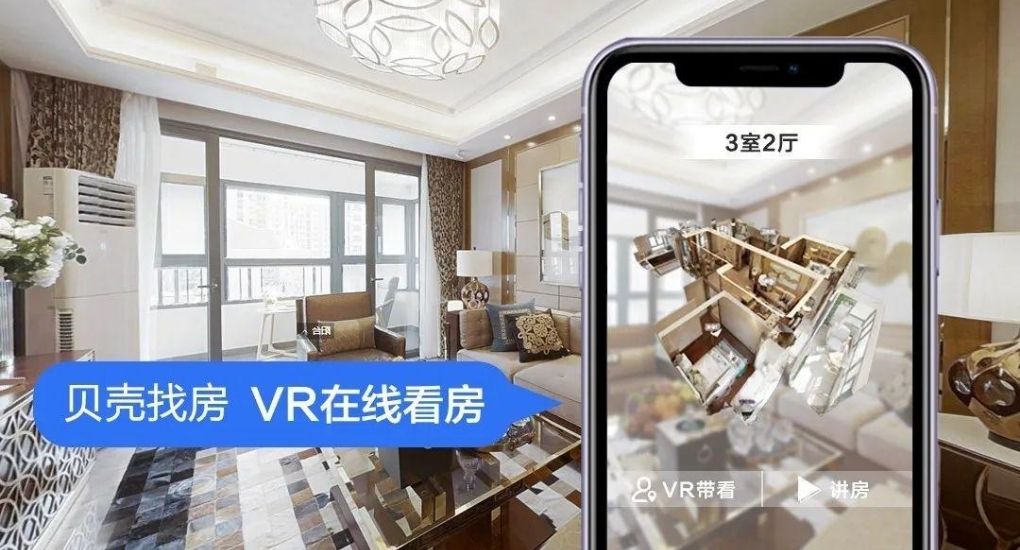
Chinese online real estate VR viewing website & APP — Beike (贝壳网)

In addition to the epidemic forcing real estate companies to explore online marketing, the current main force of apartment buyers in China is the post-80s and post-90s. They grew up in the mobile-Internet era and are willing to try new things.

Moreover, the social media and e-commerce platforms in China are in heyday, and the VR panoramic house viewing technology is mature. The combined effect of factors has promoted the continuous trend of live-streaming sales in Chinese market.

Advantages of the live-streaming real estate selling

In fact, apartment selling live-streams, as a new decentralized B2C platform for viewing, interacting, subscribing, connect directly to the B-end to C-end. In this model, there are many values.

Firstly, the content is more authentic and reliable. The traditional communication between developers and customers is flat: displays and advertisements, with moderate exaggerations and distorted propaganda. However, live house selling changes the situation. Customers can engage in real-time interactive communication and have a strong sense of participation.

Secondly, the efficiency of house viewings has been greatly improved. With the new experience tools such as VR and video, online viewing of real estate has greatly improved the efficiency and experience of viewing, which saves time and energy compared with offline visiting. “live-streams + online VR” is becoming the first filter before on-site house viewings.

Future prospects for online real property selling

Although as far as the current situation is concerned, online house selling cannot replace offline model, at least the payment of real estate must be completed offline.

The biggest significance at present of property live-streams is to attract traffic. Utilizing the platform’s and KOL & celebrities’ traffic advantage to obtain accurate target audience.

In the long term, the online real estate commerce will gradually penetrate the market, but will not take over completely the offline market mainly for the following reasons:

  • Real estate transactions are bulk consumption — star followers ≠ potential buyers.
  • Lack of trust in online purchases of bulk commodities.

However, the proportion of online and offline selling of real properties will be re-adjusted. This is also an inevitable trend for e-commerce and estate companies to adopt dual-channel integration in Chinese market.

This model is, in essence, a form of KOL and live-streaming marketing
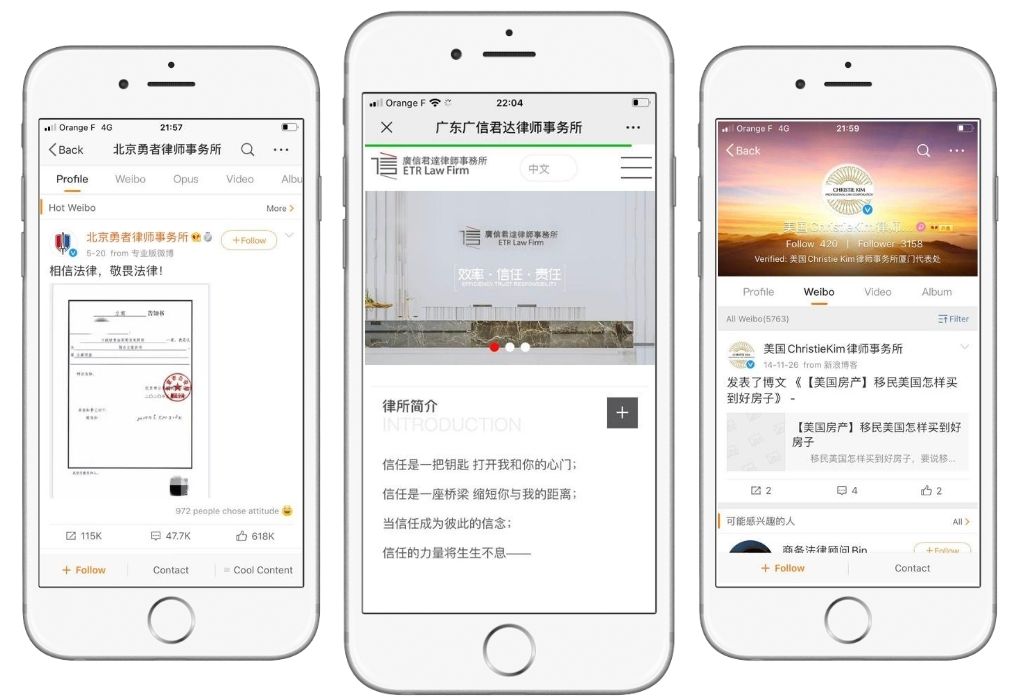
Advertising on Chinese social media

If you read all this article, you can get a conclusion that in fact the new model of selling real estate is a new application of KOL & live-stream marketing. The only difference is the merchandise in transaction, here it is real property — a special product.

Like all branding in China, the digital marketing is vital. Nowadays, the Chinese are highly connected by the Internet and social media. In return, those social networking, e-commerce platforms bring Chinese people convenience and efficiency.

EAC, an expert in Chinese digital marketing, is always at your service. If you want to know more or have any questions, contact us and we will be happy to help.

Read more:

Live Commerce Innovation in China 2027: New Formats, New Categories, New Brands

Live commerce in China matured from experiment to infrastructure between 2020 and 2027. The format that started with beauty products and snacks now covers every consumer category: cars, real estate, travel packages, medical consultations, financial products, and industrial equipment. Platforms, regulators, and consumers all adapted. China’s total live commerce GMV exceeded 5 trillion RMB in 2026, making it the largest live shopping market in the world by a factor of 20 compared to the next-largest market.

High-consideration categories entered live commerce at scale. Real estate livestreams were pioneered by Pinduoduo and Alibaba during the pandemic as property developers desperate for leads experimented with virtual home tours and live deal presentations. By 2027, major property developers like Vanke, Country Garden, and Evergrande affiliates run regular Douyin and Taobao Live sessions offering exclusive discounts to live viewers. Car dealerships and OEMs similarly run live test-drive sessions and configuration walks. These high-ticket live commerce formats generate leads and deposits, even if final transactions still close offline.

AI-generated live hosts entered mainstream use in 2026. ByteDance and Alibaba both released AI virtual host tools that allow brands to run 24/7 live sessions with a digital avatar reading from a product script. The AI hosts handle routine product introductions and FAQs, pausing to flag complex questions for a human host to answer. Brands using AI hosts report a 30-40% reduction in live hosting costs while maintaining round-the-clock platform presence. Regulatory guidance on AI host disclosure requirements is still evolving.

Regulatory oversight of live commerce tightened after several high-profile fraud cases. China’s market regulator (SAMR) and cyberspace authority (CAC) issued updated live commerce rules in 2024-2025 requiring: real-time product authenticity monitoring, mandatory return policies for live purchases, host background checks for certain categories (medical, financial, food), and AI host disclosure labels. Brands operating through certified platform merchant accounts automatically inherit platform compliance infrastructure, but must ensure their own product claims in live sessions stay within approved advertising standards.

The “mega host” era is fading, and brand-owned live is rising. After Li Jiaqi’s tax scandal and the departure of several top live hosts from platforms in 2023-2024, brands accelerated their investment in their own live capabilities rather than depending on superstar hosts. In 2027, the most successful brand-owned live operations run daily sessions with trained in-house hosts, consistent set design, and product presentation scripts that are updated weekly. Brand-owned live generates lower peak GMV than mega hosts but delivers better margin, data ownership, and long-term audience loyalty.

Technical Tips for Live Commerce in China

  • Invest in set design and lighting before anything else. Live commerce conversion correlates strongly with video production quality. A consistent, well-lit branded set with clear product staging converts 2-3x better than an improvised home setup. Budget 10,000-30,000 RMB for a permanent live studio setup — it pays back within the first month of regular sessions.
  • Run live sessions at least 3 times per week to build algorithmic favor. Douyin and Taobao Live both weight live traffic allocation toward accounts with consistent streaming history. Three sessions per week minimum is the threshold most platform insiders cite for meaningful organic traffic distribution. Start with shorter sessions (60-90 minutes) at peak hours before scaling to longer formats.
  • Use “flash deals” (秒杀) during the first 10 minutes of each session. Flash deal mechanics — a product sold at a deep discount for only the first 50-100 buyers — drive immediate viewer engagement and room entry at session start. These moments generate shares and notifications that bring in new viewers. They also signal the algorithm that your session has high engagement, which triggers broader distribution.
  • Test AI virtual hosts for off-peak hours and product catalog presentations. Deploy AI hosts for overnight sessions and product introduction segments, reserving your human host for peak hours (20:00-22:00) and promotional segments that require real-time audience interaction. This maximizes your human host’s effectiveness while maintaining 24-hour platform presence.

What Brands Say About Live Commerce Innovation

“We built an in-house live team after the mega-host market collapsed. It cost more upfront, but now we own our audience data, control our brand messaging, and pay zero host commission. Our live revenue is smaller per session than a top-host collaboration, but the annual total is higher because we stream daily instead of monthly.”

Live commerce director, personal care brand

“We tested AI hosts for our overnight sessions. The conversion rate was 60% of our human host rate, but the cost was 10% of the cost. For product catalog browsing sessions at 2am, AI hosts are completely viable. We now run AI hosts 14 hours a day and human hosts for the 6-hour peak window.”

E-commerce operations manager, home goods brand

FAQ: Real Questions Chinese Consumers Ask About Live Commerce

直播间买的东西能退吗?(Can you return products bought in live sessions?) Yes. Chinese consumer protection law applies equally to live commerce purchases. Platforms require sellers to honor the standard 7-day no-reason return policy (七天无理由退货) for most product categories. Some categories are exempt — fresh food, custom-made items, and digital downloads — but electronics, clothing, beauty, and most consumer goods must accept returns within 7 days of receipt, no questions asked. If a live host claims “no returns for this special deal,” that statement is not legally enforceable on mainstream platforms and buyers can still file a platform dispute to claim their return rights. Platforms like Douyin and Taobao have automatic buyer protection mechanisms that override individual seller return policies in most cases.

直播间的价格真的是全网最低吗?(Is the live room price really the lowest price online?) Not always, despite what hosts claim. “全网最低价” (lowest price online) is a common claim in live sessions, but verification is difficult in real time. Platforms are aware of this issue — Douyin and Taobao both prohibit hosts from making false lowest-price claims and have faced regulatory pressure to enforce this. In practice, live prices are often the lowest for the specific bundle or SKU configuration being offered, but equivalent products may be available at comparable or lower prices in standard store listings. Savvy buyers screenshot the live price and cross-check on 京东价格比较 (JD Price Comparison) or 考拉海购 before completing purchase for high-value items.


Philip Chen, CEO EAC Ecommerce China Agency

EAC builds and operates live commerce programs for international brands on Douyin and Taobao Live, from studio setup and host training to session planning, flash deal mechanics, and AI host integration.

Get a free brand audit from our team. We assess your live commerce readiness and design a practical launch plan for your brand.

Follow Philip Chen on LinkedIn: linkedin.com/in/philip-chen

Written by

Philip Chen

Philip is a specialist about Digital and e-commerce in China. Founder of Ecom China, he has been helping brands in the Chinese market for over 15 years.

Related Articles

Sectors

How to Succeed Selling Wine in the Chinese e-commerce

China is the world’s largest consumer of red wine by volume. It is also one of the most misread wine markets for foreign brands trying to enter it. The old playbook — open a Tmall store, run a few KOL posts, wait for orders — stopped working around 2022. Today, wine sales in China happen […]

Read more →
Coffe or Tea - A growing trend in China Food & Beverage

Coffee or Tea? A growing trend in China

China invented tea. Then it became the world’s fastest-growing coffee market. Now it has more fresh-brewed coffee locations than any country on earth — over 1 million stores. And a cup costs 9.9 RMB. This market is moving fast, it is brutally competitive at the bottom, and it has real openings for foreign brands at […]

Read more →
Sectors

How Should Apparel Brands Approach Chinese E-Commerce?

China is the biggest e-commerce market on earth. And fashion is its biggest category. Online clothing sales hit 1.05 trillion RMB in 2024 — 47% of all retail clothing sold in China. If your apparel brand is not in China’s e-commerce, you are missing the largest fashion market in the world. Here is how to […]

Read more →