Skip to content
E-Commerce Agency in China

Douyin’s Strategic Move into the Food Sector in China

8 min read
Matt Sun

Douyin is no longer just a short-video platform. Since 2022, ByteDance has been systematically building Douyin into a local commerce platform — competing directly with Meituan in restaurant discovery, food delivery, and F&B brand marketing.

For food and beverage brands in China, this expansion matters. Douyin’s entry into the food sector has created new marketing and distribution options that did not exist two years ago. It has also disrupted the way restaurants and F&B brands think about customer acquisition — moving attention from search-based platforms to algorithm-driven content discovery.

This guide covers what Douyin has built in the food sector, how it compares to existing platforms, and what F&B brands should be doing on Douyin in 2025.

Douyin’s Move into Local Food Services

Douyin food sector China 2025

ByteDance launched Douyin’s local life services (抖音生活服务 — Dǒuyīn Shēnghuó Fúwù) aggressively from 2022. The strategic logic was clear: Douyin already had 750 million daily active users spending an average of 100+ minutes per day on the platform. Adding local commerce — restaurant vouchers, food delivery, group meal deals — meant monetizing intent that already existed in the content feed.

Three specific areas where Douyin entered the food sector:

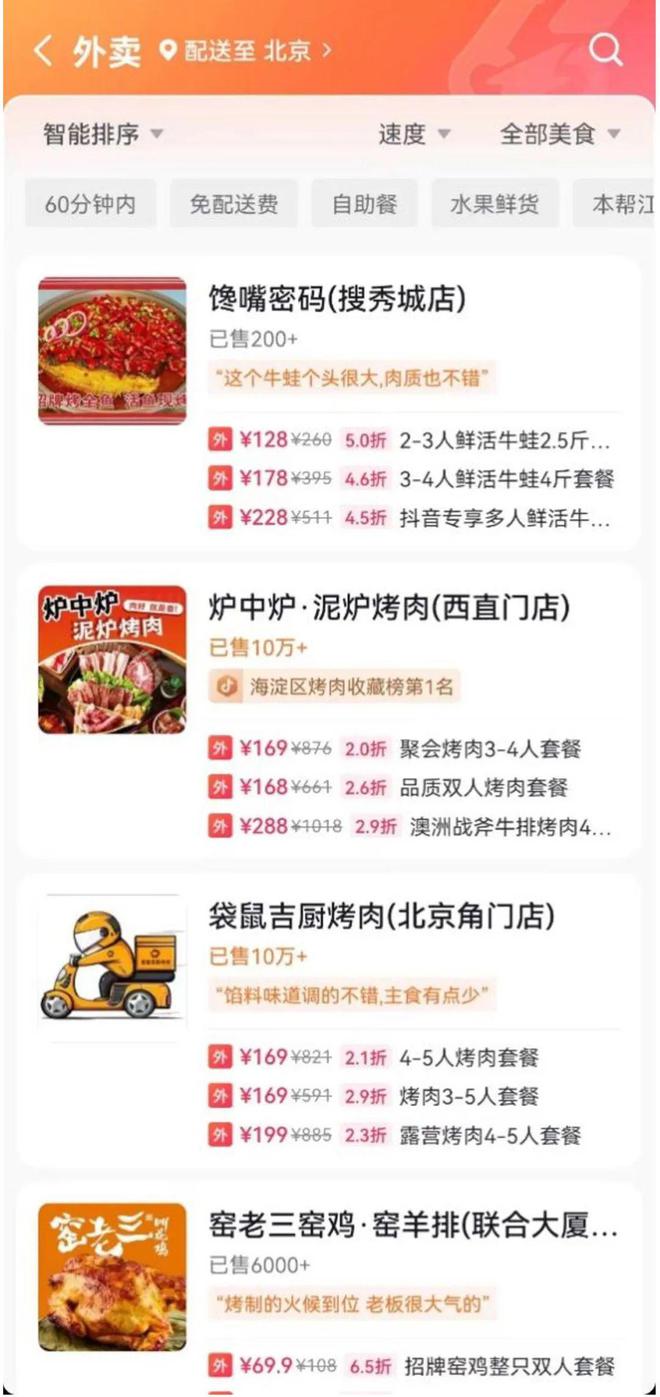
  1. Restaurant discovery and voucher sales: Douyin now lets restaurants post short videos and live streams with embedded purchase links for meal vouchers (套餐券). A consumer watches a video of a restaurant’s signature dish, taps the link, buys a discounted voucher, and redeems it in-store. This is Douyin’s most developed food commerce feature and is directly competing with Meituan’s group-buy coupon business.
  2. Food delivery: In 2023, Douyin piloted a food delivery service in Hangzhou and several other cities, integrating delivery logistics with its restaurant discovery content. The service expanded through 2024. As of 2025, Douyin delivery is available in major Tier 1-2 cities, though it has not yet matched Meituan’s city coverage or order volume.
  3. Packaged food and FMCG: Douyin Shop (抖音小店) has become a major channel for packaged food, snacks, condiments, and beverages. Brands sell directly through videos and live streams with product links to their Douyin shop. This is now one of the fastest-growing packaged food channels in China.

Douyin vs. Meituan: How the Competition Is Playing Out

The Meituan-Douyin competition in food services has been one of the defining stories of Chinese e-commerce from 2022 to 2025. Key developments:

  • Restaurant voucher market: Douyin captured an estimated 15-20% of China’s restaurant group-buy voucher GMV by end of 2024, up from near-zero in 2022. Meituan responded by lowering merchant commissions to retain restaurants on its platform. Both platforms now co-exist in this market, with restaurants running both simultaneously.
  • Content-driven discovery vs. search-driven: Meituan operates like a search tool — users open the app knowing they want food, search by cuisine or location, and browse ratings. Douyin operates through content discovery — users see a compelling video of a restaurant and click through to buy. These are different consumer moments, and smart restaurants use both.
  • Delivery scale: Meituan’s delivery network — built over 15 years — remains dominant. Douyin delivery partnerships rely on third-party logistics partners rather than Meituan’s proprietary rider network, which gives Meituan a speed and coverage advantage for delivery that will take years to close.

What This Means for F&B Brands Selling in China

Packaged Food Brands: Douyin Shop Is Now Essential

For imported and domestic packaged food brands, Douyin Shop has become a primary channel in 2024-2025. The reason is content velocity: food performs extremely well as short-video content. Recipe videos, taste tests, snack reviews, “what I eat in a day” formats — these generate organic reach that drives direct-to-shop sales without requiring the search infrastructure that Tmall depends on.

Brands that built Douyin content operations early — typically 2020-2022 — now benefit from established followings and lower content distribution costs. Brands entering in 2025 will pay more to acquire followers and content reach, but the channel still offers better organic growth potential than Tmall for discovery-driven categories.

Key metrics for food brands on Douyin in 2025:

  • Average conversion rate: video to purchase, 2-5% for well-produced food content with clear CTA
  • Live stream GMV: a 2-hour food brand live stream with an experienced host can generate 150,000-400,000 RMB in a single session
  • Top food categories by Douyin GMV: snacks, condiments, health supplements, beverages, instant food

Restaurant Brands: Voucher Sales on Douyin Alongside Meituan

For restaurant chains and food service operators with a China presence, the practical advice for 2025 is to run Douyin restaurant voucher campaigns in parallel with Meituan — not instead of it. The two platforms reach different purchase moments and different audience segments. Meituan captures high-intent search traffic; Douyin captures impulse discovery.

Restaurant short-video content that performs well on Douyin: chef’s perspective kitchen videos, behind-the-scenes sourcing stories, signature dish preparation, customer reaction content. The content does not need to be highly produced — authenticity outperforms polish in food content on Douyin. A 45-second clip of a chef plating a visually striking dish, with a voucher link, can drive hundreds of bookings at near-zero media cost.

Fresh Food and Agricultural Brands

Douyin has invested specifically in agricultural and fresh food content, partly driven by Chinese government policy supporting rural e-commerce and the 直播带货 (live-stream selling) model for agricultural producers. Fresh produce, regional specialty foods, and farm-direct products perform well on Douyin because the sourcing story — a farmer showing their orchard, a fisherman showing the catch — creates authenticity that traditional FMCG marketing cannot replicate.

For foreign food brands with traceable sourcing stories (specific farm origin, protected designation of origin, organic certification), Douyin is a particularly strong channel to communicate provenance to Chinese consumers who are willing to pay premiums for food transparency.

For more on selling food products in China’s e-commerce channels, see EAC’s Tmall food brand management and our guide to F&B brand strategy in China.

How to Build a Douyin Food Commerce Operation

Step 1: Set Up a Douyin Shop

A Douyin Shop (抖音小店) is required to sell directly within the platform. Setup requires: a Chinese business entity (or CBEC cross-border qualification for imported brands), product listings with Chinese-language descriptions and compliant food labeling, and a logistics partner capable of fulfilling Douyin orders within the platform’s delivery time standards. Work with a China-based TP or agency to complete the setup if you do not have a local entity.

Step 2: Build Content Before Paying for Distribution

Post 15-20 short videos before running any paid promotion. Find the content formats that generate engagement organically — save rate (收藏), share rate (转发), and comment sentiment are more important than raw view count for predicting purchase intent. Once you have 3-5 content formats with proven organic performance, amplify with Douyin’s paid content distribution (DOU+) and Topview ads.

Step 3: Add Live Stream as a Revenue Layer

For food brands, live stream selling works well because product demonstration is natural — cooking, tasting, comparing. Start with 1-2 live streams per week, 1.5-2 hours each, with a host who can discuss ingredients and flavors credibly. Track GMV per stream hour to optimize timing and product mix. Brands that reach 5,000+ live viewers per session should consider investing in a professional Douyin live studio setup.

FAQ: Douyin in China’s Food Sector

Can Douyin really compete with Meituan in food delivery?

In the short term, no — Meituan’s delivery infrastructure (over 5 million registered riders, 30-minute average delivery times across 2,800 cities) is not something Douyin can replicate quickly. Douyin’s food delivery service, launched in pilots in 2023, relies on third-party logistics partners (including Shunfeng and local courier networks) rather than a proprietary fleet. Coverage and speed are behind Meituan’s standards in most cities. Where Douyin competes more effectively is in the restaurant voucher and pre-purchase category — selling meal deals that consumers redeem in-store or book for future use — rather than real-time delivery. ByteDance’s stated goal is not to replace Meituan’s delivery network but to capture a share of the restaurant marketing and pre-purchase GMV that Meituan monetizes through its group-buy feature.

Source: Bloomberg Intelligence China Tech coverage (2024); PitchBook China local services market analysis (2024); Meituan Q4 2024 earnings call commentary

What food categories sell best on Douyin in 2025?

Based on Douyin’s published category data and third-party platform analysis, the top-performing food categories by GMV in 2024-2025 are: (1) snacks and confectionery — high impulse purchase rate from video content, average order value 50-150 RMB; (2) health food and supplements — including protein products, collagen, probiotics, and functional beverages where consumers research on Douyin before buying; (3) condiments and cooking ingredients — Chinese cooking sauces, spice packs, specialty oils driven by recipe content; (4) beverages — ready-to-drink teas, coffee products, and flavored waters with strong visual and lifestyle content; (5) regional specialty food — geographic-indication products (Zhejiang tea, Yunnan mushrooms, Xinjiang dried fruit) that generate authentic origin story content. Imported food categories that are growing fastest: European olive oil, Australian honey, Japanese matcha, and Korean instant noodles — all categories where the foreign-origin story and quality credentials land well in Douyin content.

Source: Douyin e-commerce annual category report 2024; QuestMobile China app analytics (Q4 2024)

Ready to launch or grow your F&B brand on Douyin? Get a free audit from our team. For more on live-stream selling for food brands, see EAC’s complete Douyin guide. Douyin merchant resources at Douyin’s merchant education center.


Matt Sun, Tmall Specialist at EAC Ecommerce China Agency. 10 years managing F&B brands on China’s e-commerce platforms. Direct experience with Nescafé, Yili, and Swisse on Tmall store management, product strategy, and campaign execution for the Chinese market.

Selling a food or beverage brand on Tmall or Douyin? Get a free audit from our team.

Connect with Matt Sun: ecommercechinaagency.com/author/matt-sun/

Written by

Matt Sun

Matt Sun is Account director at ECA , tmall expert Follow me on Twitter

Related Articles

China e-commerce

Li Jiaqi did (or not) make 25 Billion Yuans Income for Double11 ?

Li Jiaqi (李佳琦), known as the “Lipstick King” of Chinese live commerce, generated 9.5 billion RMB in sales during the 2023 Double 11 shopping festival in a single day of live streaming. His cumulative 2023 Double 11 campaign GMV exceeded 25 billion RMB across a multi-day pre-sale and sales window. For context, that is more […]

Read more →
China e-commerce

Alibaba Lets Pupu Supermarket Keep Its Independence on Taobao Shangou

On July 29, 2026, Pupu Supermarket (朴朴超市), one of China’s largest regional grocery chains with roughly 400 dark stores across ten-plus cities, quietly began listing a handful of Fuzhou locations on Taobao Shangou (淘宝闪购), Alibaba’s instant-delivery layer inside Taobao and Tmall. According to TMTPost, the rollout is explicitly a trial, with plans to cover all […]

Read more →
Food & Beverage

Chinese consumers love imported sausages (bonus Tips)

China is one of the world’s largest markets for processed meat, with a domestic pork and sausage industry that produces at extraordinary scale. Yet imported sausages — particularly European varieties — have carved out a growing and profitable premium niche that domestic products have not been able to replicate. German bratwurst, Spanish chorizo, Italian salami, […]

Read more →